


It All Started with My Colleague’s Wedding
Today, I continue to photograph high-energy moments—dance performances, theater productions, and academic conferences.
But when I trace back to where it all began, I find myself in a quieter, warmer time.
My Journey with Photography
I had been familiar with photography since before digital cameras became mainstream.
In Japan, film photography culture remained vibrant even into the 2000s, with many photographers continuing to shoot with film cameras alongside digital ones. Captivated by Teruaki Nagamine’s table photography shot with a 50mm lens, I would photograph landscapes from my travels and favorite objects with a film camera as a hobby.
I participated in a toy camera photo exhibition project with friends and experimented with a twin-lens reflex camera. Alternative photographic processes—such as cyanotype and gum printing—had a dedicated community in Japan, and I explored these techniques, searching for new possibilities in photographic expression.
After the 1995 Great Hanshin-Awaji Earthquake, I met Tetsuaki Oda at Café Nafsha, who photographed Cynthia, a service dog. Through him, I discovered the depth of photography that connects with people. He recommended the FUJIFILM TIARA II, a compact point-and-shoot camera also beloved by renowned Japanese photographer Shoji Ueda—a pocket-sized, user-friendly camera.
The Turning Point
One day, a colleague from work asked me to photograph her wedding.
In Japan, it’s not uncommon for friends or family with photography skills to be asked to capture wedding moments, sometimes alongside or instead of professional photographers. She had graduated from an American university and had traveled abroad with me. I think she asked because she had seen me taking photos.
I was uncertain whether I could do it, but I thoroughly researched composition and staging, preparing in consultation with her.
On the day, I captured everything on film—from the bridal preparations to the smiles of the bride and groom, the warm expressions of the guests, and the group photo in the garden.
Later, when my colleague saw the finished photographs, she was genuinely delighted and even showed me a handmade album she had created.
“I never knew photography could make people this happy.”
In that moment, I truly understood the power of photography.
Learning from Professional Mentors
I wanted to bring more joy to people through photography.
Guided by this desire, in 2005, I enrolled in the regional course at Quality Photo School, a women-only photography training program in Tokyo. Unlike traditional university photography programs, this was designed for working adults and offered intensive training sessions that accommodated students living outside Tokyo.
I learned directly from professional photographers, studying photography techniques with my long-desired Nikon under their strict yet attentive mentorship.
The camera I’m holding in the photo below is a Nikon FM3A, a mechanical film camera.
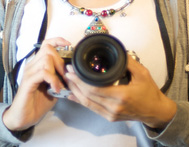
Being mechanical, it requires no battery except for the light meter function. Many Japanese photographers value mechanical cameras for their reliability—they function even in freezing or harsh conditions without relying on electronic components. Initially, I practiced wedding photography with this camera and a flash under my mentors’ guidance.
The reassurance of a mechanical camera that never misses a shutter chance—this lesson from my professional mentors remains in my fingertips to this day.
From That Day to Today
Nearly 20 years have passed since my colleague’s wedding. The feeling I had that day—”I want to make people happy through photography”—remains unchanged.
I continue to press the shutter today, connecting that “precious day” to someone else’s future.